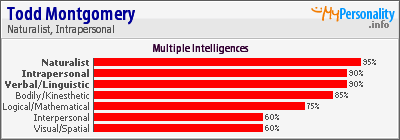
Is intelligence multiple?
Gardner's theory has provoked controversy. Only a few weeks ago an article appeared that typifies the contrary position. On my reading of Not Every Child is Secretly a Genius, Ferguson seeks to reassert that there really is only one measure of intelligence - defined as "the ability to learn" - and all people have it to varying degrees based on their "raw biological machinery of intelligence" (added emphasis mine).
 I find his phrase telling, as it suggests to me a determined effort to reduce the concept of intelligence to something mechanical in order to apply just one tool of measurement rather than admitting of multiple possibilties.
I'm not saying that "every child is a genius in his/her own special way" and everyone should get a trophy just for playing the game.
What I think is that something as complex as intelligence ought to be subject to a broader treatment than that rendered by reductionist science employed to describe "what is true" in the area of intelligence (with the attendant dire warnings against alternative views that risk leading us "down the path to intellectual relativism").
Rather than treating people as learning machines, I'm in favour of a more flexible approach.
Learning takes many forms
 Today any number of neuroscience and brain books tell the stories of how people's brains have literally rewired themselves to regain key functionality that had been lost to catastrophic illness or disease.
A less traumatic - yet no less astounding - accomplishment is described in a recent review of the book Fixing My Gaze: A Scientist's Journey Into Seeing in Three Dimensions
 . The book tells the inspiring story of a Susan Barry, who overcame the effects of being born cross-eyed and gained (I would say, "learned") stereoscopic vision in adulthood.
The reviewer's closing statement I find uplifting enough to quote at length:
With the added evidence it offers of the brain’s perennial plasticity, this book will encourage us all because it suggests that if people can reconstruct pathways of vision, there are other things they might succeed in doing. It is a pleasant and optimistic thought indeed, that at any point in life we might, if determined enough, be able to fix things, improve, mend, and grow in positive ways: even to see more clearly, and not just with our eyes.So to paraphrase Shakespeare's Hamlet: There are more things in heaven and earth, Horatio, Than are dreamt of in your reductionist scientific view. Clearly the brain is capable of many things beyond the strict confines of IQ tests. But is this talk of brain plasticity and capacity to relearn all just new-fangled neurospeak...or has it always been so?
Complex adaptive beings, not caveman-machines
A Newsweek article from last week gives a very readable summary of recent debate over evolutionary psychology (or evo-psych), a field which essentially suggests that we humans in the 21st century still operate with Stone Age minds.
That is, traits that evolved thousands of years ago to adapt to the challenges of the day have been passed down in the genes of successful survivors - reinforcing those behaviours.
Clearly humans have an ability to adapt to the environment and survive; we need only look at how our ancestors applied superior intellect and adaptive skills to successfully inhabit every corner of the globe no matter how inhospitable.
 Where the evo psych argument falls over, however, is that it assumes that our ability to adapt somehow ossified early on, rendering modern humans little more than cavemen in business suits. In sum, there is a single human nature and it was set a very long time ago.
In stark contrast, more and more research now supports a field called behavioural ecology, which "starts from the premise that social and environmental forces select for various behaviours that optimize people's fitness in a given environment. Different environment, different behaviours—and different human 'natures.'" In other words, yes humans evolved according to Darwin's theories...AND natural selection chose in favour of "general intelligence and flexibility, not mental modules preprogrammed with preferences and behaviours."
And, arguably, in favour of multiple intelligences distributed across the human population.
Complex adaptivity is therefore a hallmark of the human condition and always has been. Despite the Western impulse to reduce everything in our world to the strictly measurable, there is great merit in considering the multiple as well as the singular...lest the quest for a single "truth" devolve into the kind of arguments over right/wrong that already cripple so many human interactions, in the workplace and in society at large.
Credits: "Caveman" illustration by Peter Oumanski for Newsweek.