Author, Consultant, Executive Coach - Helping people and organizations grow into desired results
Showing posts with label learning. Show all posts

Wednesday, 6 January 2010

2010: New thinking for a new year

Summary: 2010 is the UN's International Year of Biodiversity and a great moment to learn from supposedly "dumb" animals, forget our arrogance, and remember our connection to everything that happens around us. Read why thinking holistically will help your organization in 2010 and how, paradoxically, leaders who change as little as possible in what people are doing are more likely to meet with success in their overall change initiatives.


The UN has designated 2010 the International Year of Biodiversity and I think the timing couldn't be better.

Human beings are profoundly out of touch with the world we live in and that sustains our very existence. We act as though we're above and separate from it. We even act surprised and almost personally offended when natural disasters demonstrate our vulnerability and how dependent we really are on our environment and planet.


Who's the "dumb animal"?

Human beings can be over-fond of the label "unique" as relates to our species. And nowhere is our arrogance better demonstrated than in our attitude towards other animals. Ever since Aristotle put humans at the top of what became the Judeo-Christian "Great Chain of Being" we've regarded ourselves as not just different from all other creatures, but superior.

Over the holidays I read the fascinating and very funny book Alex & Me: How a Scientist and a Parrot Uncovered a Hidden World of Animal Intelligence--and Formed a Deep Bond in the Process. Up to his untimely death, Alex the African Grey parrot provided tremendous insight into the world of animal cognition.

Consider for a moment that we commonly say bird-brain to describe someone's stupidity or lack of thought. Similarly, we use the word parroting to indicate simply repeating after someone else without understanding what they've said.

Yet this non-primate, non-mammalian creature with a walnut-sized brain learned elements of communication at least as well as a chimp (our nearest animal cousins). And Alex certainly possessed what you would call a personality, as the book repeatedly and hilariously describes.

His obituary in The Economist (no less!) summarized his many accomplishments:
By the end, Alex had the intelligence of a five-year-old child and had yet to reach his full potential. He had a vocabulary of 150 words. He knew the names of 50 objects and could, in addition, describe their colours, shapes and the materials they were made from. He could answer questions about objects' properties, even when he had not seen that particular combination of properties before. He could ask for things—and would reject a proffered item and ask again if it was not what he wanted. He understood, and could discuss, the concepts of “bigger”, “smaller”, “same” and “different”. And he could count up to six, including the number zero (and was grappling with the concept of “seven” when he died). He even knew when and how to apologize if he annoyed Dr Pepperberg or her collaborators.*
Dr Pepperberg summarized Alex's legacy as follows:
Clearly, animals know more than we think, and think a great deal more than we know. Alex taught us that our vanity had blinded us to the true nature of minds, animal and human. [...] Alex taught me to believe that his little bird brain was conscious in some manner, that is, capable of intention. By extrapolation, Alex taught me that we live in a world of thinking, conscious creatures. Not human thinking. Not human consciousness. But not mindless automatons sleepwalking through their lives, either.
How much more disgusting and shameful it is, then, that we treat animals so badly. We have long known of the intelligence of marine mammals, yet Japan secretly slaughters dolphins at Taiji and whales in the Antarctic with its illegal hunting program. Graphic videos of Chinese fur farming and the Canadian seal hunt depict sickening cruelty that can only be inflicted by those with the callous view that animals are things, not thinking, feeling beings.


The Big Picture - it's all connected

The reductionist scientific approach has traditionally sought to understand the world by looking at it from outside, breaking it down into composite parts to see how it works. Despite our arrogance in viewing humans as unique and apart from the world, the work with Alex and other similar research shows that we are not superior to all other creatures and the idea of humans' separateness from the rest of nature is no longer tenable.

Remember the Butterly Effect? This metaphor suggested that small effects in one part of an interconnected ecosystem (say, the movement of a butterfly's wings in Brazil) can produce large effects elsewhere in that system (for example, a tornado in Texas).

Chaos/complexity theory and quantum mechanics have similarly challenged the reductionist scientific view by demonstrating the interdependence of multiple forces and undermining the notion of an objective outside observer.

In short, we are a part of nature, not apart from nature. If we reckon we're the smartest of the animals, it's about time we started acting that way and pay attention to the state of our planet and fellow furry/feathered/fishy residents.


New thinking for the workplace

The lesson in 2010 for people in organizations: think holistically. Changes in one part of an organization will have knock-on and ripple effects elsewhere. Everyone is part of something bigger, and in a company you're all in the same boat - so it makes good sense to communicate with each other to ensure that boat stays afloat and on course.

With change initiatives, some leaders adopt a "change everything" approach to organizational development, seeking radical and widespread change in very short order. These leaders quickly face predictable reactions and resistance. These are the "fight/flight/freeze" responses as follows: with FIGHT people exhibit outright hostility and seek to sabotage the change efforts; FLIGHT means people pay lip-service and seem hyper-compliant but are not engaged and have effectively disconnected from the process; and in FREEZE people are overwhelmed and paralyzed, hoping it will all just go away.

By contrast, there's a positive application of the Butterfly Effect that you can use to your advantage. Since small changes can produce quite large results elsewhere over time, if you can find the right place to make a change it can often create the desired results.

So paradoxically, the leader who changes as little as possible in what people are doing is more likely to meet with success. Small changes are less scary and much less likely to evoke a fight/flight/freeze response. Successfully making a few small changes in key areas will, in turn, actually make a big difference to the organization - and do so without unleashing debilitating anger/insecurity/fear.

To find out more about how tmc can help you identify your key areas ripe for successful small changes, contact me directly.


*-On the subject of parrots, coincidentally over the holidays I also watched the documentary film The Wild Parrots of Telegraph Hill and was moved by its story of "An uncommon bond between man and nature." A great follow-on to Alex and Me, highly recommended.
.

Friday, 7 August 2009

Managing "Millennials": 6 steps to success with Gen Y (and everybody else too!)

It turns out that managing "Millennials" (a.k.a. Generation Y) isn't so different from managing everybody else...they're just more forthright in asking for - and in some cases expecting - well-balanced and people-centred management practice.

A 6-step process will help you to manage Gen Y - and everyone else in your team - to get the results you want.

At the risk of generalizing (and with a hat-tip to this useful Fast Company blog post) here are a few popular perceptions about Gen Y attitudes towards the world of work:
  • Strong parental links (some would say: being fawned and doted upon by Boomer parents) means this cohort is accustomed to having a strong sense of place, origin and position.
  • They have also been pumped up by their folks to believe they're "special" and can achieve anything. This ego-inflation has been compounded by the "you get a trophy just for participating" ethic in schools and sports, implemented for fear of stigmatizing underachievers. As a result: they expect that same kind of approval from bosses, preferably on a daily basis.
  • Facility with all sorts of technology that connects people means they have widespread social networks and an ability and willingness to engage in self-expression in any number of online forums (facebook, MySpace, twitter, blogs, You Tube, et al.).
  • Riding the wave of a boom economy and sheltered from the harsh realities of the world by their over-protective parents, young adults expect, even demand, that their jobs be fun and fulfilling.
Now before this generational portrait starts to look too much like a mob of clueless spoiled-brats and self-esteem junkies who won't deign to set foot in the workplace on anything but their own terms - let's take a step back and look at the long view.

Historically, every new generation has reaped the benefits of what's come before - better tools, improved nutrition and health and (particularly over the past century or so) techniques for developing greater self-knowledge and insight into human behaviour.

Could it be that Gen X and the Boomers are simply envious - both of the ready availability of these advantages and of Gen Y's unwillingness to settle for outdated management practice that's not much advanced from 19th-century Taylorism?

A better way of management

For years now the argument in favour of "soft skills" has been: if you treat people well, they will perform better. Command-and-control management style (a.k.a. scaring the crap out of people) admittedly gets results in the short-term...and over time produces disengagement, dissatisfaction, health problems and burnout - with all the attendant negative effects on performance and results. And forget about using C&C with Gen Y, who will simply walk.

Today the insights of neuroscience and brain research provide the hard science to back up the "soft skills" message. Below is a six-step* management process, one that will meet Gen Y demands for a more engaging management style and that will work equally well with the Gen X-ers and Boomers in your workplace.

In this brief overview I'll simply describe the function of each step. In future posts I'll offer more details on practical application to manage individuals and teams.


STEP 1- ROLE
Role starts things off on the right foot by A) establishing a sense of community (with shared values, a code of conduct, and understanding of how the group adds value in a wider context), and B) letting people know how and where each individual fits into the larger group.

Clarify the roles, goals and expectations so that each person's individual efforts are contributing to the group objectives and goals. Build a solid, agreed-upon foundation at the outset to provide an underlying source of enduring continuity in the face of transition, change and even crisis periods to come.

STEP 2 - VOICE
Voice is about expression and creativity. People are going to have thoughts and feelings about the content discussed in the previous step. It's therefore vital to now acknowledge the emotional component with dialogue and an environment that promotes the free expression of thoughts and emotional reactions. Something need not be done about every comment that is made, but people must have the chance to say what they think and feel.

Free expression like this may well cause conflict. That's normal and necessary. What is required is an agreed way to deal constructively with such conflict. This step can be quite confronting (Gen Y is not shy about self-expression!) but skip it at your peril: unexpressed emotional reactions do not go away but instead go underground to fester and bubble up in unproductive ways at inopportune moments.

When team members feel secure in freely expressing themselves, emotional reactivity is minimized and the emotional energy can be productively channeled into creative output. The advantage to doing this step well is that expression results in better understanding, clarity, enhanced creativity and group collaboration.

STEP 3 - REWARD
Reward is about motivation, action and reward - the drive to achievement that comes from the healthy expression of ego. With the emotional energy released in the previous step now ready to be put to practical use, this step answers the question "what's in it for me?" to tap into the passion and drive of each team member. It is results-focused and promotes action over words, performance over process.

"Fortune favours the bold" could be the motto...which can also mean that people "leap without looking". Therefore when describing goals make clear both the consequences of non-achievement and the benefits of achievement. Frame the task in terms of each person's self-interest - but also how achievement will benefit the team collectively. To keep people on track and productive, phrase performance measures in positive language that motivates, rather than coercive language that triggers emotional reactivity and fearful anxiety. This step is about getting things done, the achievement of aspirations.

STEP 4 - HEART
Heart is about empathy, inclusion and relationships. The previous step unleashed each person's self-interested passion and drive for results. Now is the time to ensure there is a personal connection so that internal competition does not tear the team apart.

Being smart about connecting with your people will help foster a sense of belonging for each team member. Active listening helps managers to be aware of both the explicit and implicit messages in what team members are saying, to know when something just doesn't feel right and take action to head off potential trouble before it becomes disruptive. People don't work for companies or money - they work for people. Offering a sense of personal commitment will build authentic relationships between team members, who gladly go the extra mile for you...and for each other.

STEP 5 - HEAD
Head is about data, tasks and learning. There's an old saying: "People don't care what you know, until they know that you care." In the previous step you got people to care, now you can apply the strength of those relationships to a strong task-focus.

Get clear on the step-by-step actions, make resources available, allocate them efficiently and leverage them to move forward. Ensure good information flow, analyze data for patterns to apply and exploit. Learn from experience and apply that learning to make necessary changes to strategy on-the-fly. Develop skillsets and expertise through training and encourage curiosity about how things work - and could work even better.

STEP 6 - VISION
Vision is about conceptualization, the big-picture and long-term, seeing things as they could be rather than how they are. The previous step's task-focus went right down into the weeds of details and data; now it's time to zoom back up to the 30,000-ft. perspective. Reconnect the purpose and actions of the team to the wider vision of organization and, wider still, to the trends of the industry, economy, regulatory bodies, and marketplace to consider future plans.

This final step has two important components: A) it pulls together and aligns all the previous ones by focusing on a positive future state toward which everyone can strive, and B) by celebrating what's been achieved so far, it sets the stage for reinvention, for a new foundation and the renewal of the 6-step process.

All 6 steps, every time

Regardless of our generational cohort, each of us has a preference for some of the 6 steps over others, whether Role or Reward, Voice or Vision, Heart or Head. This preference means we favour some steps and want to skip over or quickly rush through the others. As a manager, the advantage of following the 6-step format is that it ensures you address the areas that are of greatest interest to each different team member. The result: much higher levels of understanding, quality communication and better team engagement.

To find out more about how
tmc works with leaders and their teams to get results by applying the 6-step process just described, send an email today!


*-based on the six intelligence centres described in the NeuroPower framework
.

Sunday, 2 August 2009

Save-the-world Sunday: Waterlife documentary film

On a train journey from Toronto to Montreal one time, a woman from England turned to me and politely inquired, "What's the name of that lake?" I replied, "That's Lake Ontario, one of the five Great Lakes." Over an hour later, our train's route once again took us alongside a vast body of water and she turned to me, wide-eyed, and exclaimed, "Surely that's not the same lake?! It must be absolutely enormous!"

She was right, of course, it is physically enormous (although it's the smallest of the Great Lakes - the largest is more than 4 times the size and nearly 7.5 times its volume) but it's the environmental significance of the Great Lakes that is larger still.

In this Sunday's post I want to highlight a documentary film about the Great Lakes from Canada's National Film Board that I believe is well worth seeing. It's called Waterlife and below is the blurb for the film, plus a link to the interactive website.

If you are in the Sydney area, the film's Australian Premiere will take place on Thursday 20 August as part of the "Possible Worlds" Canadian Film Festival. Check it out!

No matter where we live, the North American Great Lakes - the last great supply of fresh drinking water on Earth - affect us all. As species of fish disappear and rates of birth defects and cancer rise, it seems something's not quite right with the water....

Fascinating characters tackle the big environmental issues surrounding water and explore the dangers of taking water for granted, in a film which is also an epic cinematic poem for the senses.

Filmed over a year with a variety of specialty cameras and innovative techniques, Waterlife is a documentary experience like no other. Narrated by Gord Downie, lead vocalist of The Tragically Hip, the film feature hypnotic, jaw-dropping imagery and features an ace soundtrack by Sam Roberts, Sufjan Stevens, Sigur Rós, Robbie Robertson and Brian Eno.

Winner Special Jury Award, Hot Docs Film Festival 2009

Explore the interactive multimedia website http://waterlife.nfb.ca
.

Wednesday, 8 July 2009

Creative adaptive beings, not machines

In a previous post about Howard Gardner's theory of Multiple Intelligences, I wrote that I find it a useful tool to identify one's own preferred "intelligence" as well as one's blindspots. I further suggested that the model was of value in identifying and working with people's existing abilities, to help them get the most out of what comes naturally to them and to make the most of the diversity that results from natural differences of perspective. Thus equipped, team members will be better able to respect each perspective and engage in a collaborative and productive discussion.


Is intelligence multiple?

Gardner's theory has provoked controversy. Only a few weeks ago an article appeared that typifies the contrary position. On my reading of Not Every Child is Secretly a Genius, Ferguson seeks to reassert that there really is only one measure of intelligence - defined as "the ability to learn" - and all people have it to varying degrees based on their "raw biological machinery of intelligence" (added emphasis mine).

I find his phrase telling, as it suggests to me a determined effort to reduce the concept of intelligence to something mechanical in order to apply just one tool of measurement rather than admitting of multiple possibilties.

I'm not saying that "every child is a genius in his/her own special way" and everyone should get a trophy just for playing the game.

What I think is that something as complex as intelligence ought to be subject to a broader treatment than that rendered by reductionist science employed to describe "what is true" in the area of intelligence (with the attendant dire warnings against alternative views that risk leading us "down the path to intellectual relativism").

Rather than treating people as learning machines, I'm in favour of a more flexible approach.


Learning takes many forms

Today any number of neuroscience and brain books tell the stories of how people's brains have literally rewired themselves to regain key functionality that had been lost to catastrophic illness or disease.

A less traumatic - yet no less astounding - accomplishment is described in a recent review of the book Fixing My Gaze: A Scientist's Journey Into Seeing in Three Dimensions. The book tells the inspiring story of a Susan Barry, who overcame the effects of being born cross-eyed and gained (I would say, "learned") stereoscopic vision in adulthood.

The reviewer's closing statement I find uplifting enough to quote at length:
With the added evidence it offers of the brain’s perennial plasticity, this book will encourage us all because it suggests that if people can reconstruct pathways of vision, there are other things they might succeed in doing. It is a pleasant and optimistic thought indeed, that at any point in life we might, if determined enough, be able to fix things, improve, mend, and grow in positive ways: even to see more clearly, and not just with our eyes.
So to paraphrase Shakespeare's Hamlet: There are more things in heaven and earth, Horatio, Than are dreamt of in your reductionist scientific view. Clearly the brain is capable of many things beyond the strict confines of IQ tests. But is this talk of brain plasticity and capacity to relearn all just new-fangled neurospeak...or has it always been so?


Complex adaptive beings, not caveman-machines

A Newsweek article from last week gives a very readable summary of recent debate over evolutionary psychology (or evo-psych), a field which essentially suggests that we humans in the 21st century still operate with Stone Age minds.

That is, traits that evolved thousands of years ago to adapt to the challenges of the day have been passed down in the genes of successful survivors - reinforcing those behaviours.

Clearly humans have an ability to adapt to the environment and survive; we need only look at how our ancestors applied superior intellect and adaptive skills to successfully inhabit every corner of the globe no matter how inhospitable.

Where the evo psych argument falls over, however, is that it assumes that our ability to adapt somehow ossified early on, rendering modern humans little more than cavemen in business suits. In sum, there is a single human nature and it was set a very long time ago.

In stark contrast, more and more research now supports a field called behavioural ecology, which "starts from the premise that social and environmental forces select for various behaviours that optimize people's fitness in a given environment. Different environment, different behaviours—and different human 'natures.'" In other words, yes humans evolved according to Darwin's theories...AND natural selection chose in favour of "general intelligence and flexibility, not mental modules preprogrammed with preferences and behaviours."

And, arguably, in favour of multiple intelligences distributed across the human population.

Complex adaptivity is therefore a hallmark of the human condition and always has been. Despite the Western impulse to reduce everything in our world to the strictly measurable, there is great merit in considering the multiple as well as the singular...lest the quest for a single "truth" devolve into the kind of arguments over right/wrong that already cripple so many human interactions, in the workplace and in society at large.


Credits: "Caveman" illustration by Peter Oumanski for Newsweek.
.

Thursday, 18 June 2009

Multiple intelligences - theory into reality

The idea of a single comprehensive test for intelligence (the IQ test) was challenged over 25 years ago by Howard Gardner, whose research suggested that there are many different kinds of intelligence and culminated in his current work on Multiple Intelligences at the Harvard Graduate School of Education.

Gardner describes eight forms of intelligence:
  • Verbal/Linguistic - naturally good with writing or speaking and memorization
  • Logical/Mathematical - driven by logic and reasoning
  • Visual/Spatial - good at remembering images and aware of surroundings
  • Bodily/Kinesthetic - love movement, have good motor skills and are aware of their bodies
  • Musical - musically gifted and have a "good ear" for rhythm and composition
  • Intrapersonal - adept at looking inward, self-awareness
  • Interpersonal - good with people and thrive in social interactions
  • Naturalist - sensitivity to and appreciation for nature

Know your strengths...and blindspots


It's a worthwhile exercise to identify your preferred intelligence systems. Doing so can help you understand your strengths, what interests you and give you an idea how to best focus your energy in the areas of your natural gifts and talents.

It's also helpful to become aware of which areas are of lesser interest to you and may represent your potential blindspots. This provides insight into your own areas for personal development - though on balance you may also choose to "outsource", seeking advice from people who rate highly in those intelligence systems so you can benefit from their complementary perspectives.

An additional reason to learn about how people's intelligence preferences differ is that you can then better understand some of the reasons why another person's view of the world differs from your own - sometimes quite dramatically!

Accepting the valid grounds for having preferences and perspectives that differ (i.e. they may be based on different Multiple Intelligence preferences) helps people get beyond pointless debates about "right/wrong" or "good/bad" to reach a place of "different, each with its own merits". In this mode you will then be much better equipped to value and respect each perspective and engage in a collaborative and productive discussion.

Multiple Intelligences - insights

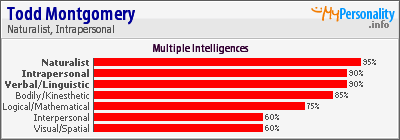
To give an example of what I mean, here are my results from an online version* of the Multiple Intelligences self-assessment:

Click to view my Personality Profile page

Major learning - my strongest intelligence is "Naturalist", which is related to nature, animals and the environment. This result surprised me in the way that happens when you suddenly notice something that's been right in front of you all along. To wit: if I just take a look at this blog's list of "adopted mascots" and its strong environmental theme then it's right there, plain as day. I like this realization because lately I've consciously noticed my enjoyment of nature and actively sought opportunities to do what I like to do and am "good" at noticing.

Biggest surprise: "Interpersonal intelligence" comes sixth(!) on the list. Now, while there is no "fail" in this test, I was surprised and disquieted by this because I've made a career of consulting in human behaviour and interpersonal dynamics, so I thought that I "should" have ranked higher here. Then I thought about it further and came to the humbling realization: I simply don't have all the answers in this field - I have as much to learn about this subject as the people who seek my expertise. This, in turn, I found quite liberating since the corollary is I don't "have to" have all the answers...and I think that ultimately makes me a better consultant, one who's able to work with what's there and collaborate with clients rather than being the pontificating "expert".

Making it real: theory into reality

By now I guess you get the idea - the multiple intelligence model is a useful tool for identifying and working with people's existing abilities, to help them get the most out of what comes naturally to them and spot potential blindspots for development work or seeking the complementary skills of others.

Of course, this should not be just an intellectual exercise. It's not enough merely to know there are differences - individuals and teams will want to know how to capitalize on this knowledge for competitive advantage!

tmconsultancy helps people find ways to manage the inevitable conflict that differing perspectives can create. People learn to talk TO each other, not past each other. This kind of useful dialogue helps channel the energy of conflict into productive activity, avoiding the miscommunication dramas and fragmented effort that hobbles teams and undermines engagement. When people learn to play to their particular strengths and teams learn to weave a powerful tapestry from the complementary talents within them, interpersonal communication improves dramatically. The outcome: better results, performance and personal satisfaction.

To find out more about how tmc can help you to turn useful theory into powerful practice, email me!
TM

*-I've no affiliation with this site; registration required, test is free
.

Tuesday, 4 November 2008

An antidote to doing too much

A recent bit of client work reminded me clearly: some things can't be rushed. To learn a powerful and multifaceted new tool and skill set, there's no cutting corners.

Take poetry for example - of late I'm reading Stephen Fry's fantastic The Ode Less Travelled: Unlocking the Poet Within.

Together Stephen and I are working to help me rediscover the appreciation of poetry first instilled in me in by my 9th grade English teacher: Mr. Tom Sherry. A gravel-voiced, rough-hewn farmer and boxer, he was just about the most unlikely guy to ever reel off Shakespearean soliloquies and stanzas of poetry, but there you have it - Mr. Sherry taught me much of what was worth knowing about life during my formative years. In fact it's from his class that I learned W.E. McNeill's phrase: "the man who knows is wanted"...so in some respects I can thank (or blame!) him for my present career in consulting.

Speaking of teachers and training, I'm reminded of what Alexander Pope wrote of learning:

A little Learning is a dang'rous Thing;
Drink deep, or taste not the Pierian Spring:
There shallow Draughts intoxicate the Brain,
And drinking largely sobers us again.
Fir'd at first Sight with what the Muse imparts,
In fearless Youth we tempt the Heights of Arts,
While from the bounded Level of our Mind,
Short Views we take, nor see the lengths behind,
But more advanc'd, behold with strange Surprize
New, distant Scenes of endless Science rise!
So pleas'd at first, the towring Alps we try,
Mount o'er the Vales, and seem to tread the Sky;
Th' Eternal Snows appear already past,
And the first Clouds and Mountains seem the last:
But those attain'd, we tremble to survey
The growing Labours of the lengthen'd Way,
Th' increasing Prospect tires our wandering Eyes,
Hills peep o'er Hills, and Alps on Alps arise!

Poetry's beauty and power lies in its ability to do much with fewer words than prose; the poet's original intent is fleshed out as the listener fills in much of the meaning, making it simultaneously more vividly real and more relevant to that person's world. It is a collaborative art form, and one that merits the time it takes to learn to do well.

Ars longa vita brevis

The life so short, the craft so long to learn.—Hippocrates c.460

Yet in learning this, as with so many complex systems, is easy to grow impatient - to watch with mounting despair as "Alps on Alps arise" to humble our laboured efforts. So many nuances, subtleties, intricacies - and time is so short! Must rush, get more done, take more classes, cram even more into each breathless moment....

It's precisely then that it pays to look not only at the many peaks still to go, but to offer oneself the satisfaction and reassurance of reviewing just how much distance has already been covered.

Another useful perspective was offered today by my Montreal-based friend, colleague and coach Magella Sergerie: the opposite of doing isn't not doing...the opposite of doing is just being. Sometimes our efforts at doing too much (or learning too much) are simply counterproductive as we need to take that breather to recharge the batteries and climb a few more of those mountains.
TM

Photo credits: the Welsh 3000's by Owain Rees

Friday, 24 October 2008

Surviving vs Thriving - insights from the Lion City

Singapore has long been a strategic nexus of commerce and trade. Here you have "instant Asia" - Indians, Chinese, Malay, Japanese - along with masses of Western and other expats and the multinational firms that employ them. Today Singapore offers many useful insights into what is happening in the region of Southeast Asia and also globally.

Out of this mix of cultures and worldviews, a particularly Singaporean view has emerged. Here the business culture is fostered on a deeply pragmatic view of the world...and yet it is not all short-term practicality. The government is strongly focused on Singapore's future wellbeing, with carefully laid-out strategies geared to the long-term objective of ensuring the city-state's place on the world map of commerce and business.

Certainly on the surface of it, with construction sites and container ports running literally 24/7/365, it seems the Lion City is poised to roar ahead through the current economic turmoil and beyond.

In my previous post I mentioned the difference in the US presidential election between McCain's politics of fear and Obama's politics of hope. During my visit over the past few days here in Singapore I've been listening to the insights of local executives and the thoughts expressed at the first Singapore Human Capital Summit. It seems as though there are two prevailing mentalities, similar in nature to the themes of fear and hope.

Let's call them surviving vs. thriving.

Surviving
This mentality is focused almost exclusively on the short-term: let's hit next month's numbers and then take it from there. It's a reactive strategy, designed to do the bare minimium required to ensure economic (and, hopefully, individual job) survival. It's therefore also bereft of long-term strategic focus, considered thought, and high-level awareness of consequences - the intended and the unintended.

Thriving
The other mentality is practical, yet future-focused. As one executive argued,
Right now I'm not putting money in marketing because who knows what the market will be doing in 6 months time. But I think it's important to invest in my people. If things don't get so bad, it means I've got a team that's ready to perform and I'll eat the lunch of my more reactive, fearful competitors who haven't similarly invested. But even if I have to shed some staff, they'll still have the skills when it comes time to hire them back later on. At worst, there's a relationship to be strengthened by developing their skills - and that relationship can also be the competitive advantage I need over other companies in a tight labour market!
Both styles, short-term and long-term, may be valid depending on context and a host of other variables. Looking at the above two philosophies, I know which company I'd like to work for. (And wasn't it an exclusive focus on the short-term that got the world into the current economic crisis in the first place...?)

Maybe here at the crossroads of Asia, the combination that Singapore has woven of "pragmatic long-termism" has some valuable insights. Straight from the lion's mouth.
TM

Monday, 22 September 2008

On the Road – insights from training and travels

Hello from the city of Cairns in tropical north Queensland. I’ve completed four days of training with Unique People on the application of the NeuroPower framework (as developed by author and strategist Peter Burow) to one’s personal development and in working with clients.

The workshop looked in-depth at how neuroscience and neurobiology offer the "hard science" behind the traditionally "soft" concepts of human behaviour and interactions. I've learned a lot about the tremendous integration of knowledge across a wide variety of disciplines to produce both hands-on consulting/coaching tools and processes for personal growth.

It’s great to be in Cairns. Up here you have Australia at its most diverse: the Reef, the Rainforest and the Red of the Outback. My new colleague and friend Joe Foster put it well I think when he said “You know, I half expect to see dinosaurs roaming through the valleys here.” There’s an ancient and primordial feel to the environment here and, as a boy who grew up in landlocked diary-farming country, I find it exotic, fascinating and – at the moment – quite grounding.

For the next several weeks I will be On the Road, and as that phrase evokes the great Beat spirit of Jack Kerouac I thought I’d share a quote of his that relates to the feeling of this place that I’ve described above:
I felt like lying down by the side of the trail and remembering it all. The woods do that to you, they always look familiar, long lost, like the face of a long-dead relative, like an old dream, like a piece of forgotten song drifting across the water, most of all like golden eternities of past childhood or past manhood and all the living and the dying and the heartbreak that went on a million years ago and the clouds as they pass overhead seem to testify (by their own lonesome familiarity) to this feeling. Ecstacy, even, I felt, with flashes of sudden remembrance, and feeling sweaty and drowsy I felt like sleeping and dreaming in the grass. (from Dharma Bums, 1957)
In the same novel Kerouac writes, “I saw that my life was a vast glowing empty page and I could do anything I wanted.”

What a great insight. You are the master of your own destiny, and your life is the canvas upon which you can write and paint the adventures of your choice – according to your rules, by your own lights. It begs the question: how many of us are willing to take full responsibility for our lives, accountability for our actions, and deal with the outcomes that arise from them?

It’s a skill not all of us have developed. Yet it’s absolutely vital, for there can be no greater responsibility than the one you take for your self. I’m not talking in the Gordon Gecko “greed is good” way, I mean in the “ensure your own oxygen mask is in place before you assist others” sense.

After all, you are the only vessel you have to take you through your adventure on the planet, yet so many people live as though they have no choice in what they do every day. And there are few things more debilitating than feeling like you have no choice in any situation - the result can be learned helplessness, depression, resentment and emotional lashing-out. So why continue to be unhappy, or play the victim?

I reckon we shy away from responsibility because it sounds scary and we might fail. So how about a reframe…Steven Covey suggests we think of it as our “response-ability,” which takes us back to Kerouac’s metaphor of a page full of our responses to the challenges and adventures of life.

When you live according to your own standard of success (rather than what you imagine everyone else is thinking) you will be happier and healthier in life.

OK let’s leave it there for now and I’ll post more insights and thoughts as my travels continue.

On that note, I’m in Cairns until 28 September, in London from 30 September -07 October, then in Canada (Montreal, Halifax and Toronto) until 16 October, followed by Hong Kong 18-21 October and finally Singapore 21-25 October before I'm back to Sydney again.

During the coming weeks I look forward to meeting more fellow travellers and friends, both On the Road and virtually, as an outgrowth of this blog.

In the meantime, travel well!
TM

Thursday, 24 April 2008

Sleep on it...and be smarter

Here I am in the Qantas Club lounge at Brisbane airport. Through a combination of lost baggage (thankfully refound) and cancelled flights I’ve been enjoying the dubious culinary pleasures on offer here for nearly seven hours. And having dozed twice on the plane and once here at my makeshift office-on-the-road, I’ve been put much in mind of the idea of sleep…

A longstanding devotee of the "power nap" (15 minutes usually does the trick for me) I was utterly chuffed (or stoked, depending on your geographical linguistic preference) to find this little gem on one of my favourite blogs.

The highlights:

…we live in a 24/7 world, fuelled by ever-present deadlines, demands and responsibilities. With so much to do and so little time, it seems tempting, or perhaps even necessary, to shave off a few hours of sleep in order to get things done. Given this chronic shortage of shuteye, wouldn't it be wonderful if a quick nap could refresh us mentally and improve our memories? Results from a recent study suggest that a mere six-minute nap may be able do just that.

More than just a pleasant diversion (or a way to keep from crashing your car on the highway during long trips) sleep plays a key role in learning:

Sleep has been shown to promote consolidation of various kinds of memory, from procedural skills (for example, learning to play a musical instrument or mastering a sport), to episodic memories (such as remembering facts and experiences learned during the day).

So, whether you’re in Australia heading into the long ANZAC day weekend or elsewhere in the world enjoying the onset of spring/autumn, my counsel to you would be: get some rest, you probably need it!

TM